
Between electricity utilities (BESCOM, Tata Power, Adani), broadband fiber (Airtel, Jio, ACT), piped gas, apartment maintenance, and credit card dues, an average Indian household pays between 6 and 12 recurring bills every single month.
In the past, you had to log into multiple netbanking portals or check paper receipts to confirm whether a bill was cleared. Today, almost all utility bills are settled via UPI apps like Google Pay, PhonePe, Paytm, or bank BHIM apps. Yet keeping track of which bills are paid and which are still pending remains frustratingly fragmented.
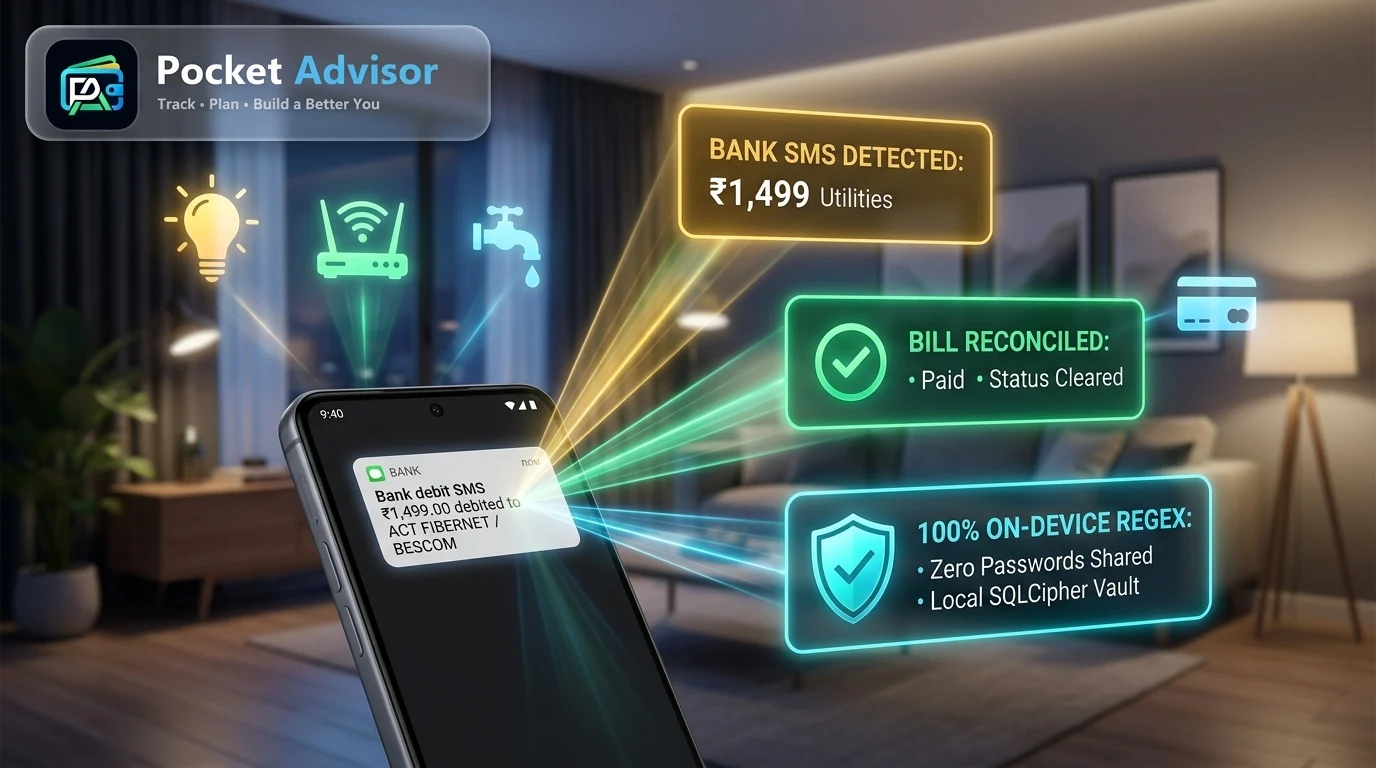
When you pay a bill via UPI, your bank sends an instant debit SMS notification. By utilizing intelligent on-device regex parsing, compatible Android apps can detect the debit amount, recognize the utility biller, and automatically reconcile the payment against your recurring bill schedule—without requiring your bank password, account aggregator credentials, or email inbox permissions.
1. The Hazards of Cloud-Based Bill Scrapers
Several popular fintech apps claim to offer automated bill tracking. However, their underlying architecture usually relies on invasive data harvesting techniques:
Architectural Red Flags in Traditional Bill Trackers
- ✓ Full Gmail / Outlook OAuth Scrapes: Demanding full access to your email inbox to scan for e-statements, which exposes confidential correspondence, travel itineraries, and OTP alerts to third-party cloud servers.
- ✓ Remote SMS Ingestion: Uploading your raw Android SMS inbox to remote databases where unredacted personal financial details can be processed for credit profiling and loan cross-selling.
- ✓ Netbanking Screen Scraping: Storing internet banking login IDs and transaction passwords to scrape account statements, directly violating RBI electronic banking security directives.
2. How On-Device Bill Matching Actually Works
When you pay your monthly broadband or electricity bill using UPI, your bank generates a standardized debit alert. Here is what happens behind the scenes in an on-device architecture:
The 4-Stage Bill Auto-Reconciliation Flow
- Bank SMS Received Locally
Your bank dispatches a transaction confirmation SMS containing the debit amount, your masked account number, the merchant VPA/handle, and a 12-digit UPI reference ID.
- Deterministic Regex Extraction
In under 1 millisecond on your phone's CPU, the parser extracts key tokens: Amount (e.g., ₹1,499), Beneficiary (e.g., ACT Fibernet), and Transaction Timestamp. OTPs and non-financial text are immediately discarded in volatile memory.
- Fuzzy Biller & Due-Date Matching
The extracted merchant is matched against your active bill list (e.g., matching 'BESCOM' to your monthly Electricity bill or 'ACT FIBERNET' to your Wi-Fi reminder).
- Instant Status Reversal to 'Paid'
The recurring bill is marked paid for the current billing cycle, duplicate alerts are silenced, and your monthly budget spending ledger updates automatically.
3. Real-World Biller Recognition Rules
Most Indian utility billers and service providers operate dedicated UPI handles on the Bharat Bill Payment System (BBPS) or merchant networks:
| Utility Category | Common Biller VPAs / Merchant Tags | Auto-Assigned Category | Matching Window |
|---|---|---|---|
| Electricity | @bescom, @tatapower, @tneb, @mahadiscom | Utilities • Power | ±7 days around bill due date |
| Broadband & DTH | @airtel, @jiofiber, @actcorp, @tatasky | Utilities • Internet | Monthly recurring cycle |
| Credit Card Bills | @hdfcbank, @icici, @sbicard, BBPS billers | Financial • Card Dues | Prior to statement due date |
| Apartment Rent | Custom UPI VPA or Flatmate PhonePe transfer | Housing • Rent | 1st to 5th of each month |
4. Setting Up Zero-Hassle Bill Tracking in Pocket Advisor
Getting your recurring bills auto-matched takes less than two minutes on Android:
Quick Bill Setup Checklist
- ✓ Add your monthly utility bills, rent, and loan EMIs in the Pocket Advisor Bill Reminder section.
- ✓ Grant SMS permissions under Google Play's Financial Money Management exception for 100% on-device detection.
- ✓ Exclude Pocket Advisor from aggressive OEM battery savers (Xiaomi, Samsung, OnePlus) to ensure timely alert processing.
- ✓ Make your usual bill payments via Google Pay, PhonePe, or BHIM. Pocket Advisor automatically matches debits and marks reminders cleared.
Experience Automatic UPI Bill Matching
Auto-detect debit SMS alerts, match recurring utility bills, and protect your financial privacy with local-first SQLCipher encryption.
Download Pocket Advisor Free →