
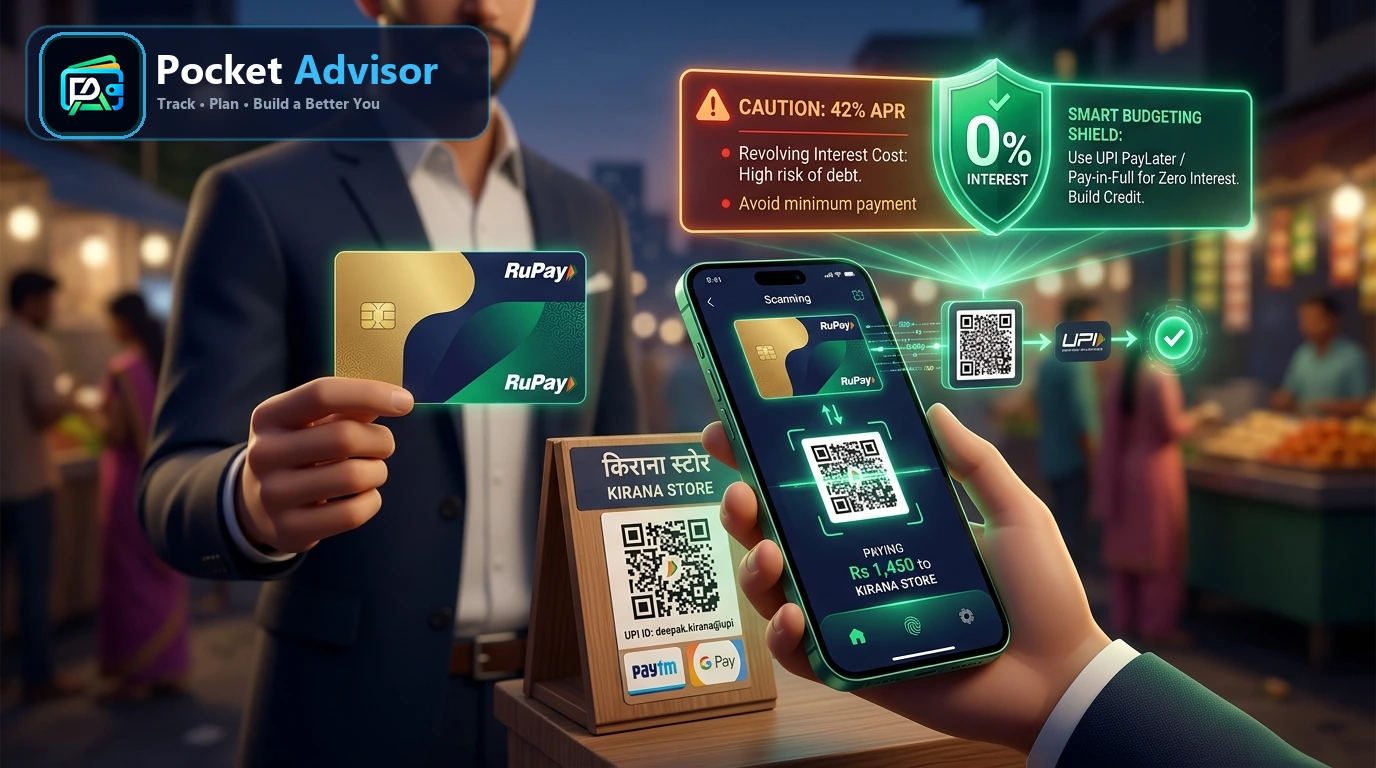
RuPay Credit Cards can be linked to supported UPI apps and used for eligible merchant payments by scanning a merchant QR code and authenticating with a UPI PIN. Availability depends on the issuing bank, app, merchant QR, and transaction category. A QR that accepts payments from a bank account does not necessarily accept a credit-card-linked UPI payment.
The practical risk is not that every QR payment is dangerous; it is that small purchases can be easy to forget when they are charged to a credit line. A few everyday scans can accumulate into a statement balance that is larger than expected. The safest approach is to track spending and treat the linked card as borrowed money that must be repaid.
1. Technical Architecture: How RuPay on UPI Actually Operates
To protect yourself, you must first understand the fundamental structural difference between standard UPI payments and RuPay Credit on UPI:
| Feature | Bank Savings UPI (Debit) | RuPay Credit on UPI |
|---|---|---|
| Transaction scope | Eligible person-to-person and merchant payments | Eligible merchant payments; P2P, P2PM and card-to-card payments are not permitted |
| Funding source | Money is debited from the linked bank account | Purchase is billed to the linked credit card |
| Merchant QR acceptance | Depends on the UPI payment flow and merchant | Must be eligible for credit-card-on-UPI payments; acceptance can vary |
| Merchant charges | Applicable rules depend on payment type | Nil MDR applies to qualifying small offline merchants for transactions up to ₹2,000; other cases depend on applicable rules |
| Interest | No credit-card interest on a normal bank-account debit | Issuer interest may apply if the card bill is not paid in full by the due date |
| Rewards and exclusions | Depends on bank/payment offer | Depends on the card issuer, card variant, merchant category and current terms |
2. The 42% APR Revolving Debt Trap: The 'Minimum Due' Illusion
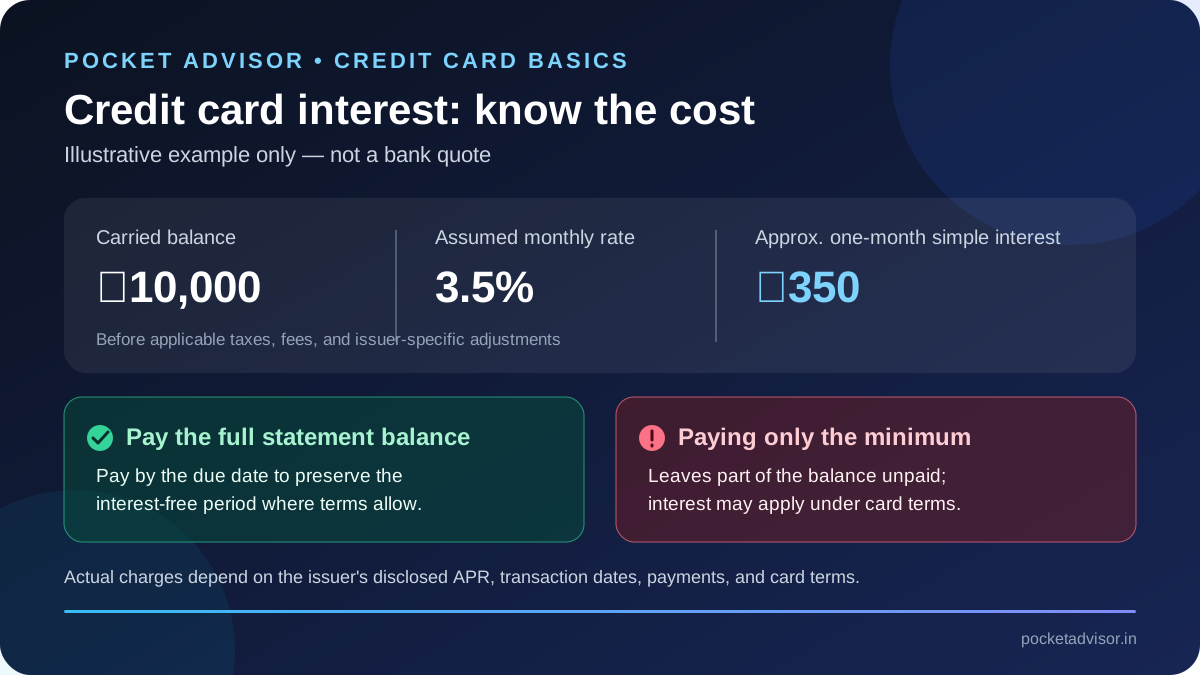
One important credit-card term is the Minimum Amount Due (MAD). For example, if a statement shows ₹20,000 total due and ₹1,000 minimum due, paying ₹1,000 may prevent the bill from being treated as wholly unpaid, but it does not clear the remaining ₹19,000 or make that balance interest-free. The exact minimum and interest calculation depend on the issuer's terms.
Paying only the minimum is not the same as paying the bill in full. RBI directs issuers to warn cardholders that minimum-only payments can stretch repayment over months or years and that the interest-free period is suspended when a previous bill balance remains outstanding. Check the card's Most Important Terms and Conditions (MITC) for the applicable rate and method.
What Actually Happens When You Pay Only the Minimum Due
- ✓ The unpaid statement balance remains outstanding after the payment.
- ✓ Interest may be charged under the issuer's card terms; the applicable rate is not identical across all cards.
- ✓ The interest-free period can be suspended while a previous statement balance remains outstanding.
- ✓ GST may apply to interest and applicable fees as shown on the card statement.
- ✓ Late-payment charges and credit reporting consequences depend on the amount paid, timing, and applicable rules.
Illustrative example (not a bank quote): suppose a card issuer charges 3.5% interest per month on an eligible outstanding balance of ₹10,000. One month's simple interest on that balance would be about ₹350 before applicable taxes and any other charges. Actual interest can differ because issuers apply their disclosed method to the outstanding amount and transaction dates; check your statement and MITC.
| Illustrative balance | Assumed monthly rate | Approx. one-month interest before taxes/fees | What to do |
|---|---|---|---|
| ₹10,000 | 3.5% | ₹350 | Check the issuer's disclosed APR and interest method |
| ₹20,000 | 3.5% | ₹700 | Pay the full statement balance by the due date where possible |
| ₹10,000 | 2.0% | ₹200 | Rates vary by issuer and card terms |
3. The Credit Utilization Ratio (CUR) Shock on Your CIBIL Score
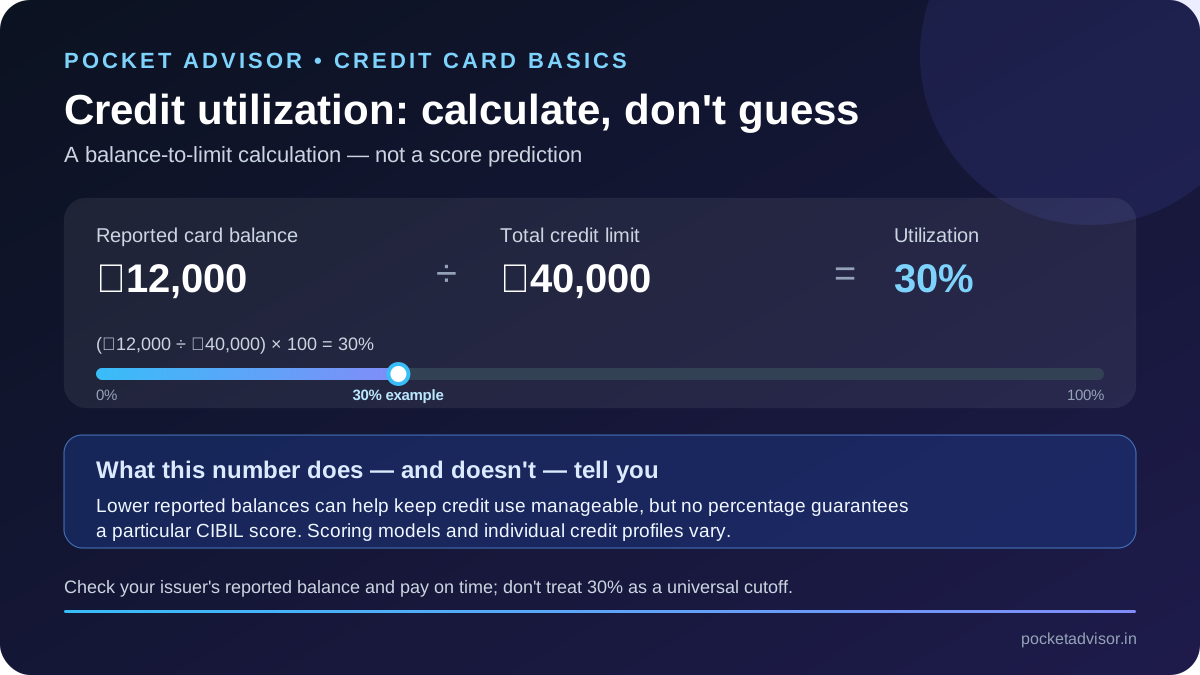
Credit utilization is the proportion of your reported card balance relative to the available credit limit. A higher reported balance can matter to a credit profile, but no single utilization threshold guarantees a particular CIBIL score change. Issuers report at particular times, so paying in full by the due date does not guarantee that every bureau snapshot will show a zero balance.
A simple way to estimate utilization is: (reported outstanding balance ÷ total credit limit) × 100. For example, ₹12,000 reported against a ₹40,000 limit is 30%. This is a budgeting reference, not a universal scoring cutoff or a promise of a specific score outcome.
Here is a practical example. Assume a ₹40,000 limit and these illustrative purchases during the month: ₹650 at a café, ₹1,200 for groceries, ₹350 for a cab, and ₹2,800 for a planned household purchase. That totals ₹5,000. If other card purchases bring the reported balance to ₹12,000, utilization would be 30% (₹12,000 ÷ ₹40,000). The example shows how to calculate your own ratio; it does not predict a CIBIL score change.
A lower reported balance can help keep credit use manageable, but scoring models are proprietary and bureau outcomes vary. Avoid claims that a fixed percentage will cause a fixed point drop; pay on time and follow your issuer's reporting and billing terms.
4. Four Golden Rules to Use RuPay Credit on UPI Safely
Step-by-Step Guardrails for RuPay on UPI
- Pay the total statement amount by the due date
Where you can, pay the total amount due rather than only the minimum. If you use autopay, confirm that the mandate is set to the total amount due and that sufficient funds are available.
- Set a personal spending limit
Choose a limit based on your budget and repayment capacity. A 30% utilization figure can be used as a cautious budgeting reference, not a guaranteed CIBIL-score threshold.
- Review the card before confirming each QR payment
Check that the selected funding source is your RuPay credit card, the merchant and amount are correct, and the transaction is permitted. Keep the receipt or transaction record for reconciliation.
- Reconcile spending against the card statement
Review bank/card SMS alerts and your issuer's app or statement. SMS delivery and parsing can vary, so do not treat any third-party expense tracker as a complete or authoritative card ledger.
5. How Pocket Advisor Keeps Your Credit in the Safe Zone
Keeping mental track of credit cycles across multiple banking apps is impossible when making dozens of UPI scans each week. Pocket Advisor solves this at the engineering layer:
Intelligent On-Device Financial Protection
- ✓ Supported bank and UPI transaction alerts may be organized from messages recognized by the app; coverage depends on bank and message format.
- ✓ Review categorized expenses to spot spending patterns, then compare the records with the card issuer's statement.
- ✓ The issuer's own app and statement remain the source of truth for credit limit, total due, interest, and payment due date.
- ✓ Pocket Advisor is designed around local encrypted transaction storage, with optional cloud backup only when enabled by the user; review the current Privacy Policy for details.
6. A practical monthly example
Imagine you link an eligible RuPay credit card with a ₹40,000 limit. During the month you pay ₹650 at a café, ₹1,200 for groceries, ₹350 for a cab, and ₹2,800 for household items. These purchases total ₹5,000. If other purchases bring the balance reported by your issuer to ₹12,000, the simple utilization estimate is 30%. Set aside money for the statement and confirm the total due and payment date in your card issuer's app. All amounts are illustrative.
7. Privacy and transaction tracking: what to verify
An expense tracker can help organize recognized transaction alerts, but SMS-based tracking is not guaranteed to capture every payment. Compare the app's records with your bank or credit-card statement, correct missed entries, and review permissions and privacy disclosures before granting access. For Pocket Advisor's product details, see the UPI expense tracker guide, automatic UPI tracking guide, and Privacy Policy.
8. Official references and further reading
Check the primary sources before relying on any fee or interest claim: NPCI — RuPay Credit Card on UPI, NPCI operating circular for RuPay Credit Cards linked to UPI, and RBI — Credit Card and Debit Card Directions. Rules, issuer rates, rewards and acceptance can change; confirm the current terms with your app and issuing bank.
Track UPI Spending With More Clarity
Use Pocket Advisor to organize supported transaction alerts and review spending patterns. Confirm balances, credit limits, interest, and due dates with your card issuer.
Get Pocket Advisor on Google Play →